What AI Customer Service Gets Wrong About Loyalty
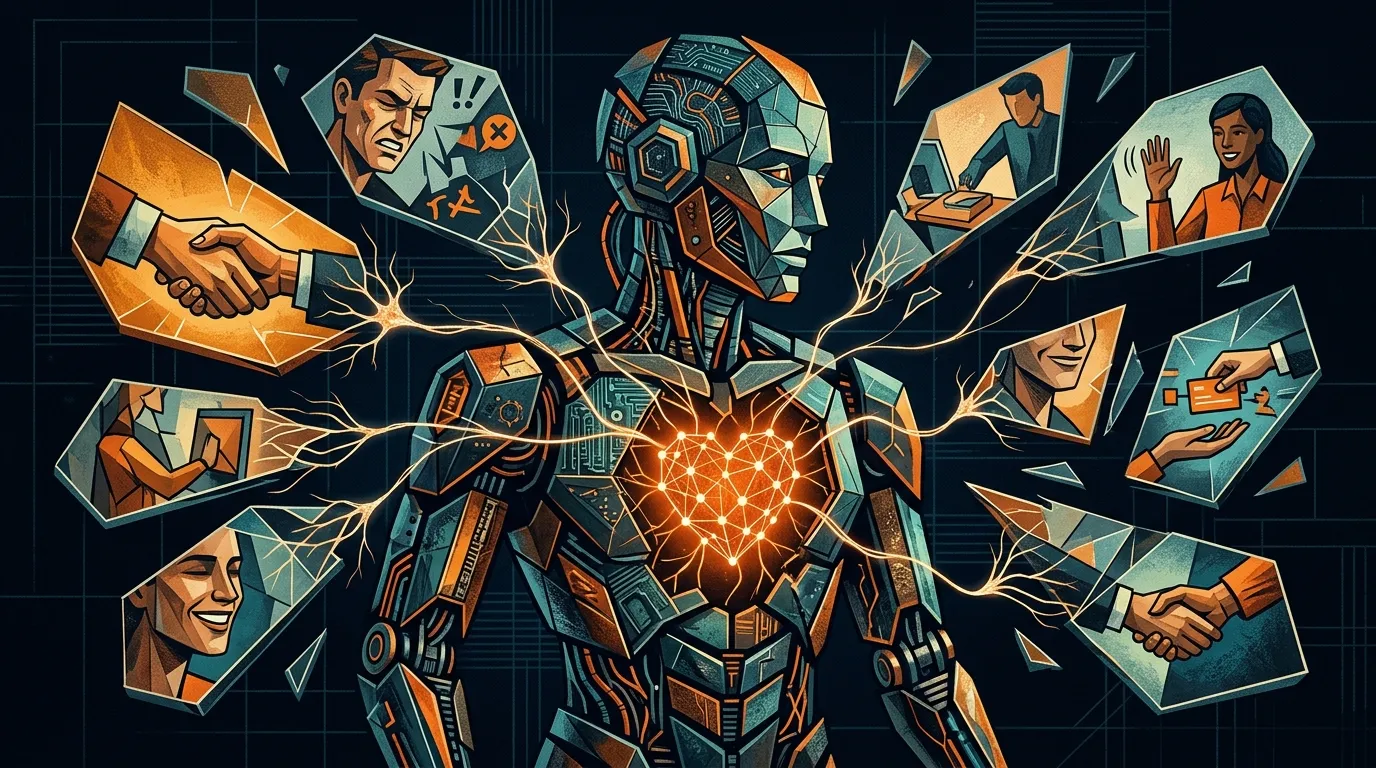
Automation is eating customer service whole. But the brands building real loyalty aren't the ones moving fastest — they're the ones thinking hardest about what their AI actually feels like.
There's a moment every frequent flier knows. You've had a rough connection, your bag is missing, and you're standing at a service desk. The agent behind the counter looks up, reads your face, and says something like, 'Let's fix this.' Not a script. Not a case number. Just a human reading the room.
Now imagine a chatbot doing that.
Most can't. Not because the technology doesn't exist to pull your flight history, your bag status, and your last three complaints — it does. The problem is that most brands deploying AI in customer service have spent all their energy on the mechanics and almost none on the meaning. They've built something that can answer questions but can't read a room. And customers feel that gap immediately, even if they can't name it.
The Efficiency Trap
Agentic AI — the kind that can take actions, not just respond to queries — is moving fast. Analysts project that within a few years, the vast majority of routine service interactions will be handled without a human ever getting involved. That's not speculation. The cost economics alone make it inevitable.
But here's what gets lost in that conversation: efficiency and loyalty are not the same thing. A customer whose problem gets resolved in 90 seconds by a bot isn't necessarily a customer who feels good about your brand. They might just feel... processed. Like a ticket that got closed.
The brands that have built genuine, durable loyalty — the ones people actually talk about, recommend, and come back to even when a competitor offers a lower price — have always understood something that's hard to put in a spreadsheet. They make people feel something. Not just satisfied. Something.
Disney is the obvious example, and it's obvious for a reason. Every detail at a Disney park is intentional. The way cast members are trained to crouch down to eye level when talking to a child. The fact that no matter where you're standing in the Magic Kingdom, you can't see a parking lot or a highway. The trash cans, famously, are placed exactly 30 steps apart because Walt Disney himself walked the park eating a corn dog and timed how long he held the wrapper before looking for somewhere to throw it. That's not obsession for its own sake. It's a philosophy — every detail either reinforces the feeling or erodes it, and there's no neutral.
Your AI agent is a detail. A big one.
The Personality Brief Nobody Writes
Before any workflow goes live, before any conversation tree gets mapped, a brand should be able to answer a simple question: what do we want a customer to feel after interacting with our AI?
Not 'satisfied.' That's too vague. Specifically — do they feel respected? Reassured? Like they're dealing with a brand that actually knows them? Or do they feel like they just fought through a phone tree?
Most brands can't answer that question because they've never asked it. They've asked 'what can we automate?' and 'how do we reduce handle time?' Those are fine questions, but they're the wrong starting point.
The right starting point is a personality brief. Human creative teams have used these for decades — they define how a brand sounds, what it values, how it handles awkward moments, what it absolutely never does. Every decent copywriter has worked from one. But most AI deployments go live without anything equivalent. The result is a bot that sounds like every other bot: clipped, slightly robotic, weirdly formal, and utterly interchangeable.
Think about what that brief would actually need to cover. How does the agent greet someone who's clearly frustrated before they've even typed a full sentence? What does it do when it doesn't know the answer — does it guess, or does it say so honestly? Does it use humor, and if so, what kind? How does it close a conversation — with a canned 'Is there anything else I can help you with today?' or with something that actually fits the moment?
These aren't small questions. They're the difference between an AI that feels like your brand and one that feels like a vendor's template with your logo on it.
Personalization Isn't a Feature, It's a Strategy
Taylor Swift has built one of the most devoted fan bases in music history, and the technology involved is... not complicated. Hidden messages in lyric booklets. Surprise appearances at fan events. Merch drops timed to inside jokes the fan community had been running for months. None of it required a proprietary algorithm. It required paying attention and then acting on what you noticed, consistently, over years.
That's the actual model. And it's one that AI can genuinely scale — if brands treat personalization as a long-term relationship strategy rather than a conversion tactic.
The difference matters. Conversion-focused personalization is 'you left something in your cart.' Relationship-focused personalization is knowing that a particular customer always orders the same thing around the third week of the month, and sending a gentle heads-up on day 19 before they even think about it. One feels like a nudge. The other feels like the brand actually pays attention.
Or consider a customer who's had two frustrating service interactions in the past month. A relationship-aware system doesn't route them through the standard queue. It flags them, surfaces their history, and gets them to someone with the authority and context to actually make things right. That's not a workaround. That's relationship management, and it's exactly what a good human account manager would do without being asked.
The catch is that this kind of personalization requires your systems to actually talk to each other. Customer history, purchase behavior, service records, communication preferences — all of it needs to be accessible at the moment of interaction. Many brands have this data. They just haven't connected it to the customer-facing layer in a way that makes it useful in real time. That's a solvable infrastructure problem, but it requires someone to decide it's worth solving.
The Handoff Nobody Practices
Ask most CX teams when their AI agent is supposed to escalate to a human. You'll often get a vague answer about 'complex issues' or 'customer request.' Push further and ask what specifically triggers that escalation, what information transfers automatically, and how the customer is told what's happening — and the conversation gets uncomfortable fast.
The handoff from AI to human is one of the most critical moments in any automated service experience. It's also one of the most neglected.
When it goes wrong, it goes badly wrong. The customer has to repeat everything they already told the bot. They wait on hold without knowing why. They get connected to someone who has no context and starts from scratch. By that point, the frustration isn't just about the original problem — it's about the experience of trying to get help. And that frustration tends to stick.
When it goes right, something interesting happens: the handoff itself becomes a trust moment. The customer feels the system working for them, not against them. The human who picks up already knows what's going on, acknowledges it, and moves forward. That transition — seamless, informed, human — can actually repair a relationship that was fraying.
Building this well requires explicit logic, not good intentions. What signals should trigger escalation? Repeated failed attempts to resolve something? Certain emotional language in the conversation? A customer whose account history suggests they need senior-level attention? All of these can be defined in advance. The context that transfers — what the bot tried, what the customer said, what was already offered — can be packaged automatically. The transition message the customer sees can be written to feel warm rather than bureaucratic.
None of this is technically difficult. It's just rarely prioritized until something goes wrong publicly.
Measuring What Actually Matters
Here's a gap that almost nobody talks about: most brands have no clear way to tell whether their AI interactions are building loyalty or quietly draining it.
Standard metrics — resolution rate, handle time, containment rate — measure efficiency. They don't measure whether the customer felt respected, or whether they'd recommend the brand to a friend after the interaction, or whether they feel more or less confident in the company than they did before. Those things matter enormously for long-term retention, and they're almost entirely invisible in the dashboards most CX teams look at.
One useful mental model is to think of every AI interaction as either a deposit or a withdrawal from the relationship. A proactive reorder reminder that saves a customer from running out of something they rely on? Deposit. A bot that confidently gives wrong information and then makes it hard to reach a human? Withdrawal. Over time, the balance of those interactions determines whether a customer becomes an advocate or quietly churns the next time a competitor offers a discount.
Adapting traditional CX metrics — Net Promoter Score, Customer Effort Score — to specifically evaluate AI touchpoints is worth doing. Not just at the end of a quarterly survey, but close to the interaction itself, while the experience is fresh. The signal you get from a customer who just had a frustrating bot experience and hasn't yet decided whether to bother complaining is more actionable than anything you'll find in aggregate data three months later.
The Values Problem
Honestly, the technology is the easy part. The hard part is organizational.
Deploying agentic AI well requires a brand to have clear answers to questions that feel philosophical: What do we owe our customers? What moments are too important to automate? Where does efficiency stop and relationship-building begin? Most companies haven't had those conversations explicitly, which means their AI deployments are making those decisions implicitly — and often badly.
The brands that figure this out first won't necessarily have the most sophisticated AI. They'll have the clearest values about what their customer experience is supposed to feel like, and they'll have built their automation around those values rather than around what was easiest to ship.
That's what Disney understood about theme parks. It's what the best music artists understand about fan relationships. And it's what the next generation of genuinely customer-centric brands will need to understand about AI.
The technology will keep improving. The question is whether the thinking keeps up with it.
Share this article
Join the newsletter
Get the latest insights delivered to your inbox.