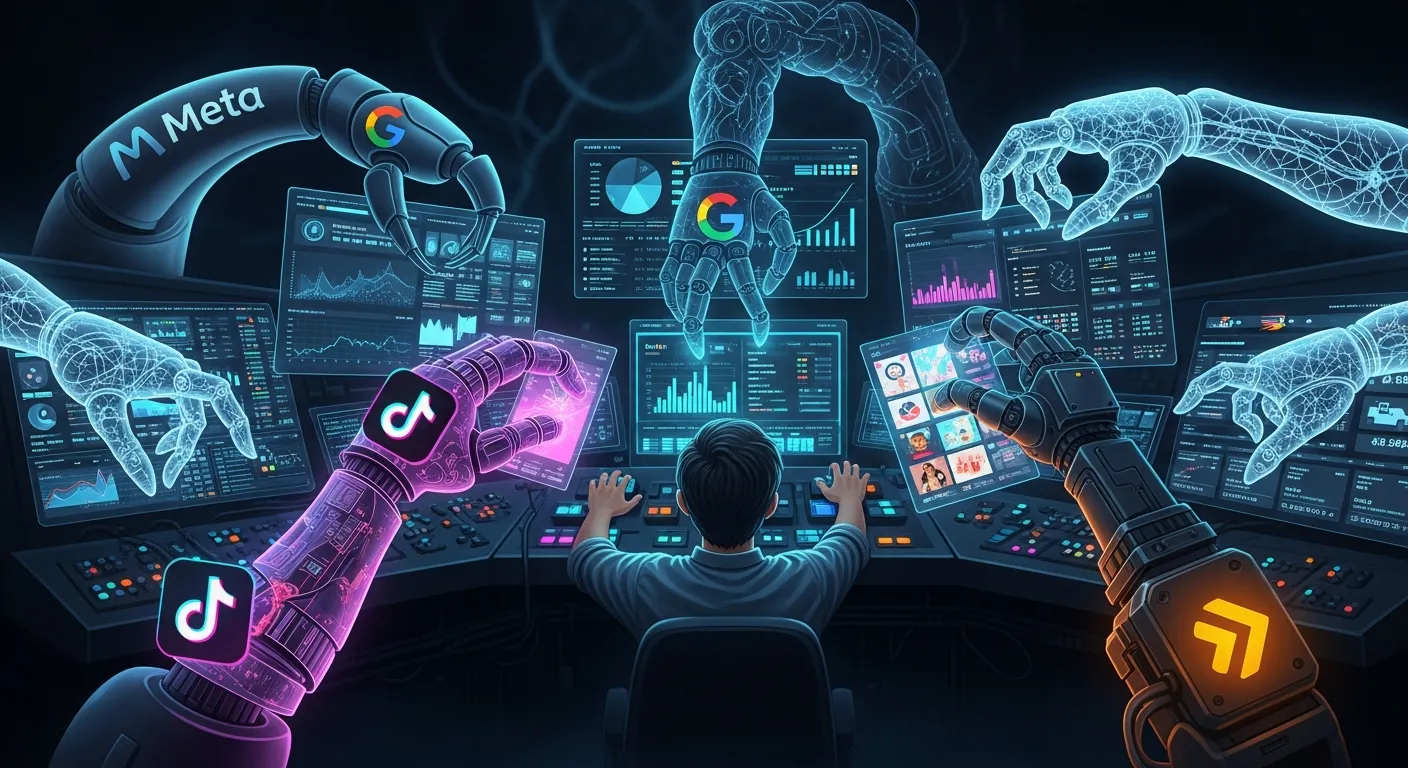
Who's Really Running Your Ad Campaigns Now?
Meta picks your audience. Google writes your copy. TikTok chooses your creative. Marketers are losing the wheel — here's how to take it back.
The Quiet Takeover Nobody Voted For
Think about the last campaign you ran on Meta or Google. Did you choose exactly who saw your ads? Did you write every word of the copy? Did you get a full breakdown of who clicked, who converted, and why?
If you answered no to any of those, you're not alone. And it's not a glitch. It's the plan.
Over the past few years, the biggest ad platforms have quietly shifted from tools you control to systems that control you. They pick your audience. They generate your creative. They decide what performance data you get to see. And they're doing it under the banner of AI-powered convenience.
The pitch sounds great: let the algorithm do the heavy lifting so you can focus on strategy. But there's a catch. When you hand over the wheel, you also hand over your ability to steer the brand. And for marketers who care about long-term relationships, not just short-term conversions, that's a serious problem.
What You've Actually Lost — And Why It Matters
Let's be specific about what's changed. There are three areas where marketers have lost real ground.
Audience Control
Old-school media buying was deliberate. You studied who read a magazine, who watched a show, who visited a site. You made a judgment call about whether those people matched your customer profile. You chose how often to reach them.
Even early programmatic advertising let you set audience parameters. You might not control every placement, but you could define the person you wanted to reach.
That's mostly gone now. Tools like Meta Advantage+ and Google Performance Max don't ask who you want to reach. They decide. Their algorithms optimize for the outcomes the platform defines as success — usually clicks or conversions. That sounds efficient, but it creates a real blind spot.
What happens when you're launching a product to a completely new audience? What happens when you're building brand awareness in a market where you have no conversion history? The algorithm has no signal to work with. It defaults to your existing customers. Your expansion goals go nowhere.
Creative Control
Now the platforms don't just pick your audience. They write your ads too.
Meta Advantage+, Google Performance Max, and TikTok Smart+ can generate ad creative automatically. You upload some assets — images, headlines, maybe a video — and the system remixes them into whatever format it thinks will perform best on whatever placement it chooses.
In theory, this saves time. In practice, it means your brand voice, your visual identity, and your messaging hierarchy are all subject to machine judgment. The platform optimizes for engagement metrics. You care about brand consistency and long-term perception. Those goals don't always line up.
And it gets more extreme beyond paid social. When your products show up in AI search summaries or marketplace listings, you have almost no say in how they're described. The platform writes the story. You just hope it's accurate.
Data and Measurement
Here's the part that should worry every marketer with a budget to defend. Platforms are sharing less performance data than they used to. Audience breakdowns are thinner. Attribution details are murkier. And increasingly, platforms want you to just trust their reports.
That's a significant ask. You're being told to spend money based on performance data provided by the same company collecting that money. The conflict of interest isn't subtle.
Without independent measurement, you can't verify what's working. You can't optimize across channels. You can't build the kind of institutional knowledge that makes marketing better over time.
Why Platforms Are Doing This — And Why It Won't Stop
It's worth pausing to understand the incentive structure here. Platforms aren't taking control away from marketers out of malice. They're doing it because automation scales better than manual control.
When Meta runs Advantage+ campaigns, it can process signals across billions of users and optimize in real time. No human media buyer can match that computational speed. So from a pure performance standpoint on existing audiences, the algorithm often does win.
But the platform's definition of winning isn't the same as yours. A platform wins when ad spend stays on the platform and generates measurable short-term results. You win when your brand grows, customer relationships deepen, and lifetime value increases. These are related goals, but they're not identical.
The trend will continue. AI capabilities are expanding, not contracting. More channels — connected TV, podcasts, digital out-of-home — are being pulled into automated ad networks. The question isn't whether this shift will reverse. It won't. The question is how you operate effectively inside a system that's not designed around your interests.
Practical Ways to Push Back
You can't opt out of the modern ad ecosystem. But you can make smarter choices about where you spend, how you build your audience, and how you measure results.
Find Platforms That Still Give You the Wheel
Not every platform has gone full automation. Smaller ad networks, niche publishers, and some retail media platforms still let you define your own targeting parameters and supply your own creative without algorithmic remixing.
Linear TV and print media still work the way they always did. You choose the placement. You control the message. The audience is defined by the medium. These channels aren't right for every brand, but for campaigns where strategic reach matters more than algorithmic efficiency, they deserve a second look.
Even on Meta and Google, fully automated programs are still optional — for now. Manual campaigns still exist. Use them when precision matters.
Build Channels You Actually Own
The most durable response to platform dependency is building direct relationships with your audience. Not through paid media, but through channels where you set the rules.
Email newsletters let you reach subscribers on your terms. Branded podcasts build loyalty over time. Live events create the kind of face-to-face connection no algorithm can replicate. A YouTube channel or content library gives you a permanent asset that doesn't disappear when a platform changes its algorithm.
The key is to think long-term. These channels don't drive immediate conversions. They build the kind of trust that makes every other marketing effort more effective. Treat them as infrastructure, not campaigns.
Don't Overlook the Touchpoints You Already Have
Marketers often focus on reaching new customers while ignoring the moments they already own. Your product packaging is a marketing touchpoint. Your customer service interactions are a marketing touchpoint. Your delivery experience, your onboarding flow, your app interface — all of these shape how customers feel about your brand.
A chatbot on your website can answer questions and guide purchase decisions. A well-designed product dashboard can cross-sell and deepen engagement. These aren't glamorous marketing tactics, but they're entirely under your control and they reach people who already have a relationship with you.
Get Serious About Independent Measurement
If you're relying on platform-reported metrics to make budget decisions, you're flying partially blind. You need a measurement system that doesn't depend on the same companies selling you the ads.
Retail sales data is one of the most reliable anchors you can use. It connects marketing activity to actual purchase behavior without going through a platform's attribution model. Marketing mix modeling, though resource-intensive, gives you a channel-agnostic view of what's actually driving results.
The goal is to build a measurement framework that lets you evaluate any channel — new or old, paid or owned — on consistent terms. That's how you make confident decisions when platforms give you incomplete information.
Prepare for the AI Search Reality
When someone asks ChatGPT or Google's AI Mode about a product in your category, your paid ads don't appear in the answer. What appears is whatever the AI decides is most relevant based on the content it has indexed.
This is a different kind of control loss. You can't buy your way into an AI summary. You have to earn it through content quality, authority signals, and structured data that makes your information easy for AI systems to read and use.
Think about the questions your customers ask before they buy. Create clear, accurate, well-structured content that answers those questions. Make sure your product information is consistent across every place it appears online. This is the new version of SEO, and it's worth treating with the same seriousness.
The Bigger Picture: Rethinking What Control Means
Here's a reframe worth considering. Marketers have always operated within constraints. You couldn't control who picked up a newspaper. You couldn't control whether someone fast-forwarded through your TV spot. You couldn't control which search results a person clicked.
What you could control was your strategy, your message, and your relationship with your audience. That's still true. The platforms have changed, but the fundamentals haven't.
The marketers who will do best in this environment are the ones who stop trying to fight the algorithm and start building things the algorithm can't replace. Deep customer relationships. Distinctive brand voices. Owned audiences. Independent data. These aren't just defensive moves. They're the foundations of durable marketing advantage.
The platforms will keep automating. Your job is to make sure the things that matter most to your brand stay firmly in your hands.
Where to Start
If you're feeling overwhelmed by how much has shifted, pick one area and start there.
If your measurement is weak, fix that first. You can't make good decisions without reliable data, and everything else depends on knowing what's working.
If you have no owned audience, start building one. A newsletter with a few hundred engaged subscribers is worth more than a million impressions on a platform you don't control.
If your brand voice is getting lost in automated creative, look for ad formats and placements where you still control the message. They exist. You just have to look beyond the default options.
The platforms aren't going away. But neither is your ability to build something they can't automate away. That's the real marketing challenge right now — and it's a more interesting one than optimizing a click-through rate.
Share this article
Join the newsletter
Get the latest insights delivered to your inbox.