Why Your Feedback Loop Is Broken (And How to Fix It)
Vague feedback isn't a people problem—it's a format problem. Here's why the way feedback arrives matters more than how much you get.
The Phrase That Sounds Fine But Isn't
You send a design mockup to your team. Someone replies, "Looks good to me." You feel a small wave of relief. Progress.
Except two weeks later, a user reports the exact issue that "looks good" was supposed to catch. Sound familiar?
The problem isn't that your teammate was careless. The problem is that "looks good to me" is almost meaningless as feedback—and the system you're using practically guarantees you'll keep getting it.
You Don't Have a Feedback Shortage. You Have a Format Problem.
Most small teams think they need more feedback. More testers, more users, more opinions. But quantity isn't the real bottleneck.
Think about how feedback actually arrives on your team right now. A Slack message with no screenshot. A screenshot with no context. An email that says "the button looks off" without specifying which button, on which page, in which browser.
Every one of those reports lands in your lap as a mystery to solve. What did they mean? Where exactly is it? Is it reproducible? You end up spending more time decoding the report than fixing the actual issue.
That decoding work is invisible, but it's expensive. For a solo founder or a two-person team, it can quietly eat hours every week. And as your product grows, it only gets worse.
Why People Give Vague Feedback (It's Not Laziness)
Here's something worth sitting with: the people giving you fuzzy feedback aren't trying to be unhelpful. They're working within the tools you've given them.
A website is a visual, interactive experience. But the tools most teams use to collect feedback—chat apps, email threads, shared docs—are built around text. You're essentially asking people to describe a painting using only words, then acting surprised when the description doesn't quite capture what they saw.
Imagine someone tries to tell you a button looks wrong on mobile. In Slack, they type: "Hey, the checkout button seems a bit off on my phone." That's it. No device info. No screenshot. No indication of which checkout page, which step in the flow, or what "off" actually means visually.
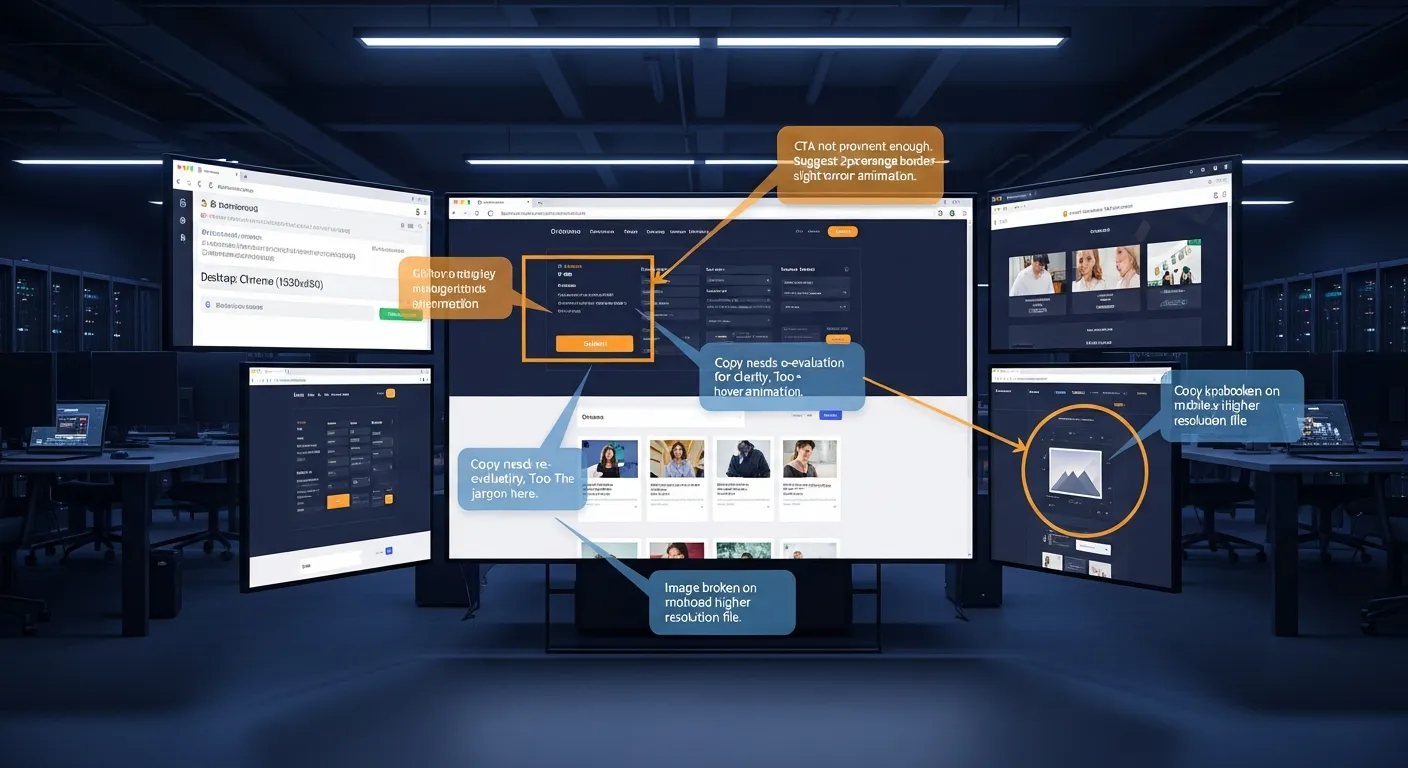
Now imagine instead they could just tap the button directly and leave a pinned comment right on it. Suddenly the feedback is precise, located, and actionable—without requiring any extra effort from the reviewer.
Change the format, and the behavior follows. That's the core insight here.
The Hidden Tax on Founders Who Route Vague Feedback
There's a role that never appears in any org chart: the person who translates fuzzy reports into real tasks. On most small teams, that person is the founder.
Every vague report becomes a series of micro-decisions. Is this worth investigating? What did they actually mean? Should I ask for more info, or just try to reproduce it myself? Is this a one-off or a pattern?
None of these decisions are hard on their own. But they stack up. And unlike writing code or talking to customers, this routing work doesn't compound. It doesn't make tomorrow easier. It just fills the day.
The good news is that this tax is almost entirely a product of bad feedback formats. Fix the format, and a huge chunk of that routing work disappears on its own.
What Good Feedback Actually Looks Like
Useful feedback has three qualities that vague feedback almost never has.
First, it's located. The feedback is attached to the specific element, section, or page it refers to—not floating in a chat thread somewhere. When feedback lives next to the thing it's about, you don't have to hunt for context.
Second, it's context-rich. Good feedback includes the technical details that matter: what browser the reviewer was using, what screen size they were on, what URL they were looking at. These details are easy for a machine to capture automatically. They're hard for a human to remember to include manually.
Third, it's low-friction to leave. This one's easy to underestimate. If leaving precise feedback takes more effort than firing off a quick message, people will fire off the quick message every time. The easier you make it to be specific, the more specific people will be.
Most feedback systems fail on all three counts. They're text-first, they rely on humans to remember context, and they make precise reporting harder than vague reporting.
The Build-in-Public Problem Nobody Talks About
If you share your work publicly—posting WIP designs on social media, running open betas, asking your audience for input—the format problem gets even more acute.
Public feedback arrives fast and in volume. And when it's unanchored—just comments in a thread or replies to a post—it's nearly impossible to act on at scale. You end up with a flood of opinions and no clear way to connect any of them to specific parts of your product.
Anchored, context-rich feedback changes that dynamic. Instead of drowning in a firehose of reactions, you get a sortable queue of specific, located reports. That's the difference between feedback that paralyzes you and feedback that helps you ship.
Three Shifts That Actually Move the Needle
You don't need to overhaul your entire workflow to fix your feedback loop. A few targeted changes make a big difference.
Make precise feedback the easy path, not the hard one. Right now, firing off a vague message is faster than leaving a detailed report. Flip that. Use tools that let people point directly at what they mean, rather than describing it in words. When pointing is easier than describing, people point.
Stop relying on humans to capture technical context. Browser version, viewport size, operating system, page URL—none of these should require manual input from a reviewer. That's exactly the kind of detail a tool can capture automatically, and exactly the kind of detail a human will forget half the time.
Keep feedback attached to the thing it's about. A comment pinned to a specific page element stays useful for weeks. A comment in a Slack channel is gone by afternoon. When feedback lives with the thing it references, it's findable, actionable, and doesn't require anyone to play archaeologist in a chat history.
The Bigger Picture: Quality Over Quantity
There's a temptation in early-stage product work to treat feedback like a numbers game. More testers, more surveys, more opinions. But ten pieces of vague feedback are worth less than two pieces of precise, located, context-rich feedback.
The goal isn't to collect more input. It's to collect input you can actually act on without spending an hour figuring out what it means.
When you fix the format of your feedback loop, something interesting happens. The same people—your teammates, your beta users, your audience—start giving you dramatically better input. Not because they've changed, but because the system finally makes it easy to be helpful.
For a small team, that's not a minor improvement. It's hours back in your week, clearer priorities, and fewer bugs that slip through because "looks good to me" didn't actually mean what it sounded like.
Your feedback loop probably isn't broken because you have the wrong people in it. It's broken because the format makes it nearly impossible for good people to give you good information. Fix the format first. Everything else gets easier from there.
Share this article
Join the newsletter
Get the latest insights delivered to your inbox.