Winning Back Customers After the Automation Backlash
Too much automation pushed customers away. Here's how smart businesses are rebuilding trust with real humans, real data, and better tools for their teams.
The Automation Bet That Didn't Pay Off
Not long ago, full automation looked like the smartest move a business could make. Cut costs. Scale fast. Replace repetitive tasks with bots. Leaders across every industry rushed to automate their customer service, and many felt proud of the results — at least on paper.
Then the customer feedback started rolling in. And it wasn't good.
Customers weren't just mildly annoyed. They were leaving. Churn rates crept up. Satisfaction scores dropped. People stopped recommending brands they once loved. The problem wasn't that automation existed — it was that companies used it to replace human connection entirely.
When every touchpoint is automated, every interaction feels the same. There's no warmth. No judgment. No flexibility. Customers began to feel like ticket numbers, not people. And once trust erodes, it's incredibly hard to earn back.
So what does rebuilding actually look like? It comes down to three practical shifts that put people back at the center of your service model — without throwing away the technology you've built.
Why Customers Stopped Trusting Automated Systems
Think about the last time you got stuck in an automated phone loop. You pressed option after option. You repeated yourself to a chatbot that didn't understand you. You finally gave up and just accepted a bad outcome because fighting for a real person felt exhausting.
That frustration is now the norm for millions of customers. And it's not just an inconvenience — it's a trust killer.
Here's the core problem. Automation works beautifully for simple, predictable tasks. Tracking a package. Resetting a password. Checking a balance. But the moment a customer has a real problem — something emotional, complex, or outside the script — automation fails them completely.
Gartner's research has flagged that over-reliance on generative AI in customer-facing roles is actively eroding customer trust. When a customer feels like a company is hiding behind technology to avoid real conversations, they don't just get frustrated. They start looking for competitors who will actually talk to them.
The fix isn't tearing out your tech stack. It's knowing when to step in front of it.
Move 1: Make It Easy to Reach a Real Person
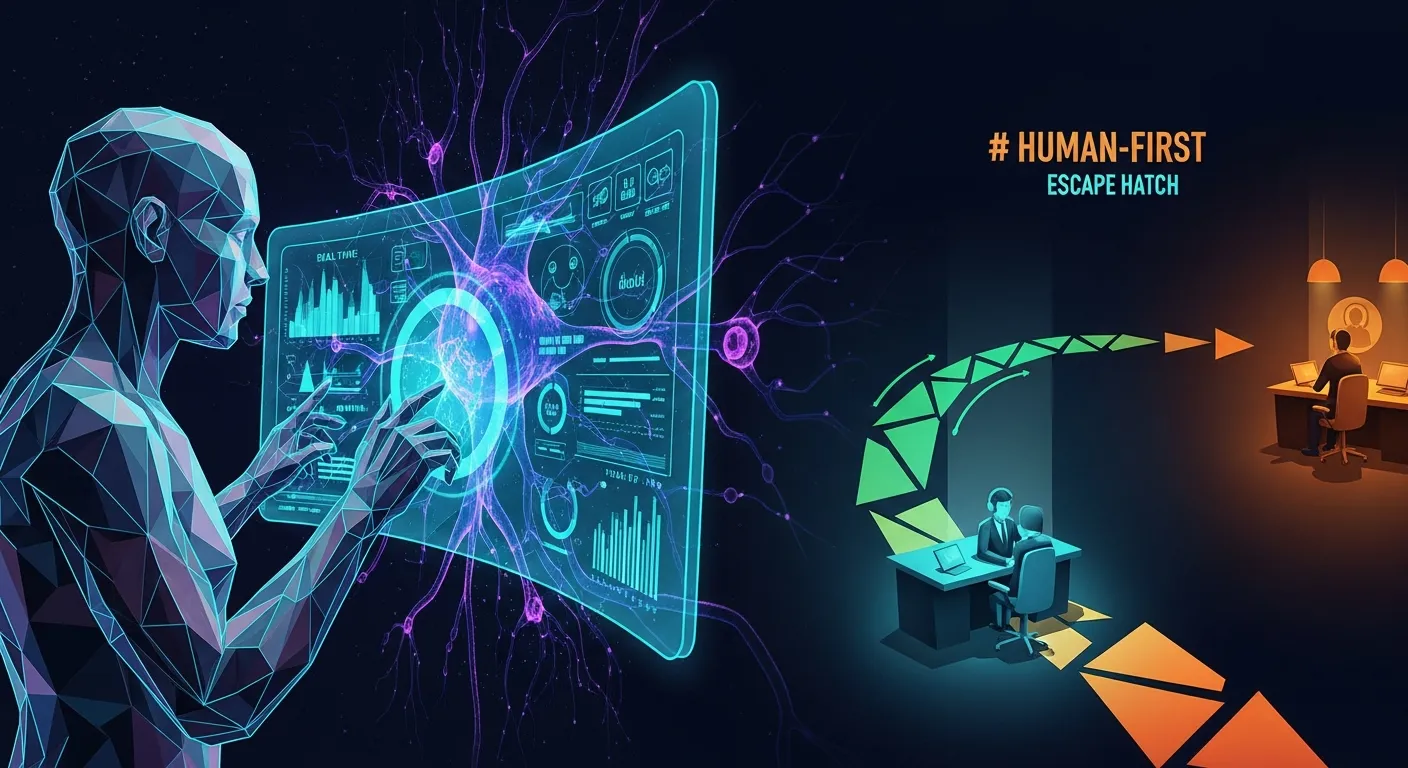
The most powerful thing you can do right now is build a clear, fast path to a live human being. Call it an escalation path. Call it an escape hatch. Whatever the name, the goal is the same: no customer should feel trapped by your automation.
A smart rule of thumb is the two-turn limit. If your chatbot or phone system can't resolve a customer's issue within two exchanges, route them to a live agent — automatically, with no extra steps required. Don't make customers beg for a human. Don't hide the option behind seven menu layers. Make it obvious and easy.
But here's where many companies get this wrong. They connect the customer to a live agent and then make them start over from scratch. The agent has no idea what was already discussed. The customer has to repeat their name, their account number, and their entire problem. That experience is arguably worse than the bot.
Your systems need to pass context seamlessly. When a customer gets transferred, the agent should already know who they are and what they need. That single change can turn a frustrating handoff into a moment that actually rebuilds trust.
One more piece matters here: give your agents real authority. A frontline rep who has to escalate every decision to three levels of management can't actually help anyone. When you trust your team to solve problems on the spot — issuing a credit, approving a fix, making an exception — you send a clear message to the customer. We value your time more than we value our convenience.
That message lands. And it sticks.
Move 2: Replace Promises With Proof
Marketing promises used to be enough. A company said they'd deliver great service, and customers took them at their word. That era is over.
Today's customers want to see the work. They want evidence, not assurances. And businesses that figure this out early are pulling ahead of competitors who are still sending monthly status reports and hoping no one asks questions.
Think about what your customers actually worry about. They want to know: Did you do what you said you'd do? Did it happen on time? How do I know it was done right? If your answer is a PDF summary sent at the end of the month, you've already lost the trust battle.
Real-time visibility changes everything. When customers can see operational data as it happens — task completions, service logs, progress updates — they stop second-guessing you. They stop sending worried emails. They stop opening tickets to ask if something got done. The proof is right there.
This concept is sometimes called a Proof of Performance loop. Instead of claiming results, you show them. Instead of telling a client their facility was serviced, you show them a timestamped log from the field. Instead of promising a ticket was resolved, you send an automated confirmation the moment it closes.
The practical shift looks like this: move from monthly reports to live dashboards. Move from reactive ticket systems to proactive alerts. Connect your field operations to your client-facing tools so there's no gap between what's happening and what the customer sees.
When customers have that kind of visibility, your service becomes proactive by default. They're not chasing you for updates — they already have them. And that transparency builds more trust than any marketing campaign ever could.
Move 3: Fix What's Broken Behind the Scenes
Here's a truth that doesn't get enough attention in customer service conversations. You can't deliver a great experience to your customers if your employees are fighting bad tools every single day.
Many organizations invest heavily in customer-facing technology while completely neglecting the systems their frontline teams actually use. Executives get sleek dashboards and real-time analytics. Customer service reps get slow, fragmented software that requires ten clicks to pull up a single account.
That internal friction doesn't stay internal. It shows up as delays for the customer. It shows up as errors. It shows up as agents who sound distracted or uncertain because they're toggling between five different windows just to answer one question.
The fix starts with observation. Spend time watching your team do their actual jobs. Count the steps it takes to resolve a standard issue. Look for the moments where the process slows down or breaks. You'll likely find that the biggest bottlenecks aren't people problems — they're tool problems.
Once you've identified the friction, simplify. Integrate your CRM with your field operations data so agents always know what's happening on the ground before they pick up the phone. Reduce the number of systems your team has to switch between. Design your internal tech stack around the people who use it most — not the people who approve the budget for it.
There's also a cultural piece here. Recognize and reward the team members who go above and beyond using your tools. When employees see that operational excellence gets celebrated, they're more motivated to use the systems well. And when culture aligns with technology, the customer experience improves almost automatically.
The Hidden Cost of Treating Service as an Expense
There's a mindset problem at the root of the automation backlash. Too many leaders looked at customer service and saw a cost center. Something to minimize. Something to automate down to the lowest possible overhead.
But customers don't experience your cost-per-ticket metrics. They experience how they feel when they interact with your brand. And right now, a lot of them feel like an afterthought.
The companies that are rebuilding trust fastest share one thing in common. They've stopped treating service as a line item and started treating it as a relationship. They use technology to make human interactions better — not to eliminate them.
That's a subtle but important distinction. Smart automation handles the routine. Humans handle the moments that matter. And when those two things work together instead of competing, customers notice.
They notice when they get to a real person quickly. They notice when that person already knows their situation. They notice when they can see exactly what's being done for them. And they notice when the employee they're talking to actually has the power to help.
Where to Start This Week
You don't need to overhaul everything at once. Start with your escalation path. Map out exactly how a frustrated customer reaches a live agent right now. Time it. Count the steps. If it takes more than two minutes or three clicks, it's too hard.
Then look at what you're sharing with customers about your work. Are you sending reports, or showing real-time proof? If your transparency is lagging, pick one operational data point you could expose to clients this month and build from there.
Finally, sit with your frontline team. Ask them what slows them down. Ask them what tool they'd fix first if they could. Their answers will tell you exactly where the customer experience is quietly breaking down.
Trust isn't rebuilt through a single campaign or a press release. It's rebuilt through consistent, visible action — day after day, interaction after interaction. The businesses that understand this are already pulling ahead. The ones still optimizing for automation rates are about to find out what their customers have been trying to tell them all along.
Share this article
Join the newsletter
Get the latest insights delivered to your inbox.