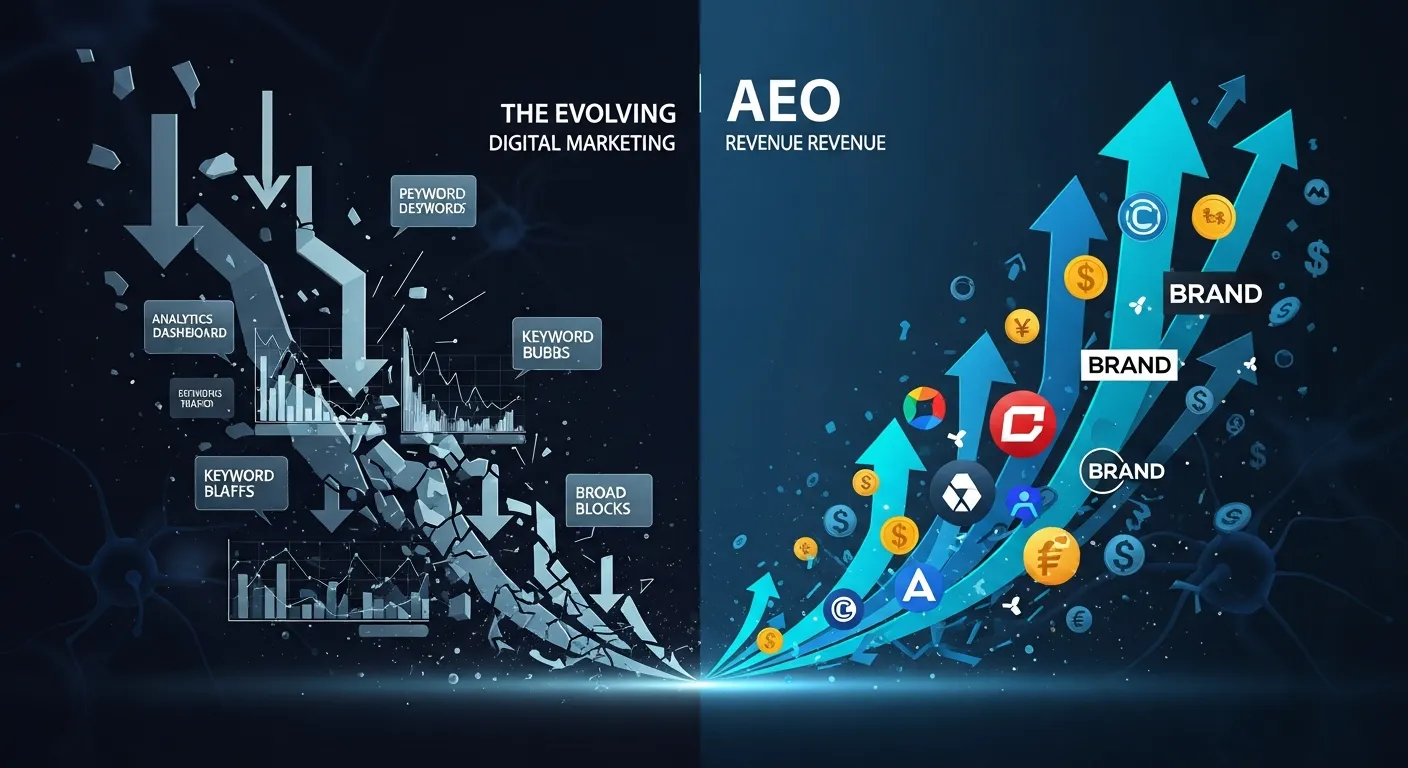
AEO: Does It Actually Work or Just Sound Good?
Traffic is falling. Revenue is rising. Answer Engine Optimization is turning old SEO logic upside down. Here's what's actually happening and why it matters.
The Weird Paradox Hitting Marketers Right Now
Imagine watching your website traffic drop month after month while your sales keep climbing. Most marketers would panic. A few are starting to realize this is actually a sign something is working.
That something is Answer Engine Optimization, or AEO. And the question worth asking right now isn't whether you've heard of it. It's whether you understand what it's actually doing to your business.
Search has changed in a fundamental way. AI tools like Google's AI Overviews, ChatGPT, and Perplexity now answer questions directly. Users get what they need without ever clicking a link. This means your content can influence a buyer's decision without them ever visiting your site. That's not a bug. For brands that adapt, it's a feature.
What Zero-Click Search Actually Looks Like at Scale
Zero-click search isn't new. But it's grown fast. Research from SparkToro and Datos tracked it rising from around 50% of searches in 2019 to roughly 68% by 2026. That's a significant shift over just a few years.
Now layer in AI Overviews. When Google's AI Overview triggers on a query, the zero-click rate jumps to around 83%. And for informational searches — the kind where people want answers, not products — AI Overviews appear in an estimated 99% of results.
Think about what that means for a content team. You write a detailed guide. It ranks well. Impressions hold steady. But sessions keep falling. The content is being read. Just not on your site.
This is the new normal. And it's why the old traffic-first mindset is starting to break down.
Why Fewer Visitors Might Mean Better Business
Here's the part that surprises most people. Less traffic doesn't have to mean less revenue.
One marketing firm saw organic sessions drop 18% while organic revenue climbed 22% over the same period. The explanation makes sense once you think it through. AI Overviews act as a filter. Casual browsers get their answer from the AI summary and move on. The people who still click through are the ones who want more. They're further along in their decision. They're ready to act.
This changes how you should think about your audience. A smaller group of high-intent visitors can be worth more than a larger group of people just browsing. The math shifts. Conversion rates go up. Revenue follows.
But here's the catch. Your analytics won't show this clearly. AI-assisted discovery doesn't leave a clean trail in most reporting tools. A user reads an AI summary that cites your brand, decides to buy, searches your name directly, and converts. Your last-click attribution model records a branded search. It gives zero credit to the AI citation that started the whole journey. Most teams look at this data and conclude AEO isn't working. They may be drawing exactly the wrong conclusion.
How AI Retrieval Works Differently Than Traditional Search
To understand AEO, you need to understand how AI engines find and use content. It's not the same process as traditional search ranking.
Old SEO rewarded pages with strong backlink profiles, high domain authority, and keyword density. The goal was to land on page one of a list of ten links. AI search works differently. The engine interprets the intent behind a query. Then it scans for content that directly answers that intent. It weighs relevance, freshness, and structure. It synthesizes an answer from multiple sources.
This creates a surprising opportunity. A page sitting on page two of Google — one that traditional SEO would consider underperforming — can appear prominently in an AI-generated answer if it's structured clearly and answers the question directly. Domain authority still plays a role. But content clarity and structure now carry real weight that can override traditional ranking signals.
James Bishop, VP of marketing at Vanillasoft, framed it well. He said content written for AI retrieval needs a different mindset. Instead of asking how to rank, you ask what you want the AI to say about you. That's closer to brand messaging than keyword strategy. It's a shift in how content teams should think about their job.
What AEO Actually Requires From Your Content
So what does structuring content for AI retrieval actually look like? It's less complicated than many people expect.
The core idea is making your content easy to extract. AI engines scan for clear, direct answers. They favor content that gets to the point fast. They respond well to structured formats like FAQ sections, question-based headings, and concise definitions. They also prefer content that's been updated recently — research suggests AI-cited pages tend to be notably fresher than pages that rank in traditional search results.
A few practical changes make a real difference. Start sections with a direct answer to the question the section covers. Don't bury the key point three paragraphs in. Use FAQ schema markup so AI engines can identify question-and-answer pairs clearly. Write headings as actual questions your audience is asking. Include sourced data where you can, since AI engines favor content that demonstrates factual grounding.
Brands that pair these structural changes with solid SEO fundamentals — good site architecture, strong internal linking, reliable technical performance — tend to see citation gains across multiple AI platforms within weeks. That's not a long runway to wait for results.
Rethinking the Metrics That Actually Matter Now
This is where many marketing teams get stuck. The dashboards haven't caught up with the behavior change.
If you're still measuring content success primarily by organic sessions and click-through rates, you're measuring the wrong things. Those metrics made sense when every search ended with a click. They're increasingly misleading in a world where AI summaries answer the question before anyone clicks.
The metrics that matter now include citation share — how often your brand or content appears in AI-generated answers for relevant queries. They include branded search volume, which tends to rise when AI citations are driving awareness. They include conversion rate among organic visitors, since the composition of that audience is shifting toward higher intent. And they include revenue per organic session, which often moves in the opposite direction from raw traffic volume.
Shifting your reporting framework takes effort. It requires buy-in from leadership who may be used to seeing traffic as the headline number. But teams that make this shift stop misreading their results. They stop pulling back on strategies that are actually working.
The Window for Early Movers Is Closing
AEO isn't a fringe experiment anymore. The market for tools and services built around AI search visibility has grown quickly. More consumers now turn to Google for AI-generated responses than to standalone AI tools, which means the behavior is embedded in mainstream search habits, not just among early adopters.
Brands that move early on AEO get a compounding advantage. Citation share builds over time. AI engines develop patterns around which sources answer certain topics well. Getting into those patterns early is easier than displacing established sources later.
The risk of waiting isn't just missing traffic. It's missing the moment when a prospective customer forms an opinion about your brand — before they ever reach your website. If AI-generated answers consistently reference competitors and omit your brand, that shapes perception at the very start of the decision process. By the time someone reaches your landing page, the comparison may already be over.
AEO isn't about chasing a trend. It's about showing up where decisions are actually being made. That place has moved. The brands adapting now are the ones that will hold ground when the shift is complete.
Share this article
Join the newsletter
Get the latest insights delivered to your inbox.