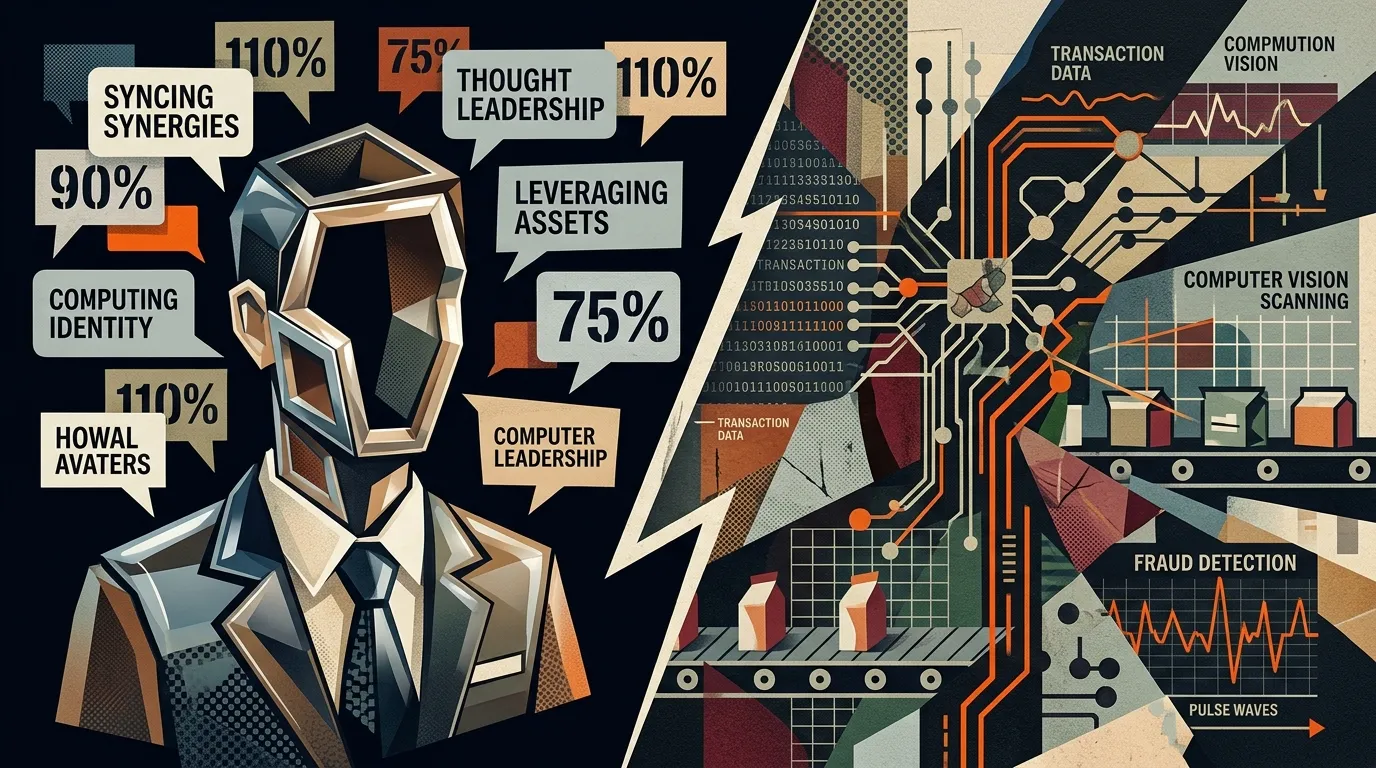
AI in CX: How to Tell Who's Actually Done It
LinkedIn is full of AI experts who've never shipped anything. Here's how to tell the difference between someone who's done it and someone who talks about it.
There's a tell. It's subtle, but once you see it, you can't unsee it.
Ask someone who works in AI and customer experience what the hardest part of their last deployment was. The practitioner will pause, maybe grimace a little, and then give you something specific — a data pipeline that collapsed every time volume spiked, a model that performed beautifully in staging and embarrassingly in production, a stakeholder who pulled support three weeks before launch. The theorist will give you a framework. They'll talk about 'alignment challenges' and 'change management at scale' in the same tone a travel writer uses to describe a city they visited once for a weekend.
This isn't a small distinction. It's the whole ballgame.
The Credential That Actually Matters
Customer experience as an industry has always had a soft spot for abstraction. Maturity models, north-star metrics, journey maps that look gorgeous on a slide and bear almost no resemblance to what a real customer does at 9pm on a Tuesday when their order is wrong. AI didn't create this tendency — it just handed it a rocket booster.
Here's the thing about tools like ChatGPT, Claude, or Gemini: they're genuinely impressive to use. You can prompt your way to a polished-sounding strategy document in under an hour. You can build a demo that wows a room. You can develop a confident vocabulary around concepts you've never actually had to operationalize. The tools are that good. And that's exactly the problem — because using them fluently has almost nothing to do with deploying AI inside a real organization, with real data, real constraints, and real consequences when something goes sideways.
Driving a car doesn't make you a mechanic. Eating at good restaurants doesn't make you a chef. And prompting an AI tool daily, no matter how skillfully, doesn't make you someone who understands what it takes to wire a model into a live customer operation. The gap between those two things is enormous — and it's where most of the confusion in this industry lives.
What bridges that gap is deployment experience. Not demos. Not decks. Not conference keynotes about the future of empathy at scale. The credential is: have you shipped something into production, watched it fail in ways you didn't anticipate, fixed it, and then been accountable for the metrics it produced? If the answer is yes, you've earned an opinion. If the answer is no, you're still in the audience.
The Numbers Nobody Posts About
Here's what makes the current moment genuinely strange. Open LinkedIn on any given day and you'll find an unbroken stream of AI success stories — pilots that transformed operations, implementations that delighted customers, strategies that unlocked entirely new revenue streams. The energy is relentlessly triumphant. You'd think every organization that touched AI in the last two years came out the other side with a case study worth publishing.
The research tells a very different story.
MIT's work on generative AI pilots found that the vast majority — somewhere around 95% — show no measurable impact on the P&L. Not 'modest impact.' Not 'impact that's hard to quantify.' No impact. The RAND Corporation's analysis of AI project outcomes found failure rates that are roughly double what you'd expect from conventional technology projects, and the reasons aren't technical. They're organizational: leadership that misunderstood what the technology could actually do, data that was never in good enough shape to support a model, and teams that got excited about the technology itself rather than the specific problem they were trying to solve.
Do the math on that. If the majority of AI initiatives are genuinely failing, and yet virtually everyone presenting at conferences or posting thought leadership is describing success — somebody is either describing a pilot that never made it to production, or a production deployment that never got honestly evaluated. The gap between the success rate in the research and the success rate on stage is too large to explain any other way.
Theorists talk about what AI will do. Doers know what it actually took — and they're usually a lot quieter about it, because the story involves things like a CRM with years of duplicate records, or a model that drifted when customer behavior shifted and nobody noticed for six weeks.
Why the Messy Middle Never Makes It to the Keynote
Real AI deployment in customer experience has a texture that's almost impossible to fake if you haven't lived it. It's worth being specific about what that texture actually feels like.
When a practitioner hears 'train the AI on your customer data,' they don't nod along. They start mentally cataloguing the problems hiding inside that sentence. Which data? The CRM where the same customer appears under three different email addresses? The ticketing system where half the resolution notes just say 'resolved' with no detail? The billing platform that disagrees with the product platform about what a customer actually purchased? Data quality isn't a footnote in enterprise AI deployments — it's usually the whole project. Months of work that never shows up in a vendor demo, because vendors don't demo the part where you spend eight weeks just getting your data into a state where a model can learn something useful from it.
Then there's the integration work. Getting a model to produce good outputs in a controlled environment is genuinely the easy part. Getting those outputs into the actual workflow — the CRM, the ticketing system, the agent desktop, the real-time decisioning layer — is where projects stall. And keeping it working when upstream systems change, when data formats shift, when call volume spikes on a holiday weekend, is a different problem again.
And then there's drift. Models trained on last year's customer behavior don't automatically stay accurate as that behavior changes. Someone has to own the monitoring. Someone has to notice when accuracy drops and understand why. Someone has to make the call about retraining and manage the disruption that creates for the team depending on the model's outputs. That person — the one who gets paged at 11pm because something moved in the wrong direction — is a practitioner. The person who wrote a LinkedIn post about 'the promise of adaptive AI' is not.
None of this friction lives inside a chat window. You can't prompt your way to understanding it. You have to have been in the room.
Chatbots Are the Shallow End
The public conversation about AI in customer experience has narrowed to an almost comical degree. Ask most people what AI in CX looks like, and they'll describe a chatbot. Deploy a bot, deflect some tickets, call it a transformation. Put it on a slide with a containment rate number.
Chatbots aren't useless. But treating them as the primary lens for AI in customer experience is like judging a city's restaurant scene by whether it has a McDonald's. It's not wrong, exactly. It's just nowhere near the full picture.
The genuinely interesting AI applications in customer experience are almost all invisible to customers in the moment — which is exactly why they work. Fraud detection that flags a suspicious transaction before a human analyst could have read the alert. Predictive models that identify customers likely to churn weeks before any obvious signal appears, giving the retention team time to actually do something about it. Voice-of-customer analytics that process every support interaction and surface patterns that would take a human analyst months to find manually. Real-time personalization that adjusts what a customer sees based on their behavior in the current session, not their demographic bucket.
These systems share a common characteristic: they're deeply integrated into operations, they run on substantial data infrastructure, and they require ongoing human expertise to maintain and improve. They're also where organizations that have done this seriously tend to find actual, measurable value — not in the chatbot that handles FAQs, but in the model that prevents the problem from becoming a customer interaction in the first place.
Customers, interestingly, seem to have figured this out on their own. Research from Gartner suggests that people are significantly more likely to reach for a general-purpose AI tool than a company-built chatbot when they need help — and that chatbot adoption has been essentially flat for years despite heavy investment. The customers aren't being difficult. They're just going where the experience is actually better. General-purpose AI tools have improved dramatically. Many company chatbots haven't kept pace, and customers can feel the difference immediately.
A Simple Way to Sort the Room
If you're trying to figure out whether someone giving you AI advice has actually done the thing, a few questions cut through the noise faster than any credential check.
Ask what broke. Genuine practitioners answer this immediately and specifically. They have a story, often more than one, about something that failed in a way they didn't anticipate. Theorists pivot to vision. They'll tell you about the potential, the roadmap, the opportunity — anything except a specific failure and what they learned from it.
Ask who owned the metric when it moved in the wrong direction. In real deployments, somebody's name is on the dashboard. Somebody gets the call when accuracy drops or cost-to-serve climbs. If the person you're talking to can name that person — or better, if they are that person — you're getting advice from someone with skin in the game. If they look slightly confused by the question, you're not.
Ask what the data situation was before the project started. The answer to this question is almost always 'messier than expected' for anyone who's actually done it. If someone tells you the data was ready and the implementation went smoothly, either they got extraordinarily lucky or they're describing a demo.
And ask for the denominator behind any percentage they cite. 'We improved resolution rates by 34%' sounds impressive until you ask: 34% of what? Over what time period? Compared to what baseline? Genuine practitioners know their denominators. They've had to defend them to finance teams and skeptical executives. Theorists often don't, because the numbers came from a vendor slide rather than a dashboard they owned.
The Organizational Problem Nobody Wants to Talk About
Here's what the research on AI failure rates points to that rarely gets discussed: most AI projects don't fail because the technology didn't work. They fail because the organization wasn't actually ready to use it.
That means leadership that approved a pilot without a clear theory of how it would change outcomes. Data governance that was never mature enough to support the model being asked to run on it. Teams that were handed an AI tool without enough context to trust its outputs — so they ignored it, worked around it, or used it selectively in ways that undermined the whole business case. Change management that got treated as a communication exercise rather than a fundamental redesign of how work gets done.
This is the part that's hardest to learn from a conference. You can absorb frameworks for organizational readiness. You can read case studies about change management best practices. But the actual experience of sitting with a team that doesn't trust a model's recommendations, and figuring out why, and rebuilding that trust incrementally — that's not something you can shortcut. It takes time, and it takes failure, and it takes the kind of patient, unglamorous work that doesn't make for a compelling LinkedIn post.
The organizations that are actually getting value from AI in customer experience tend to share a few characteristics. They started with a specific, well-defined problem rather than a broad mandate to 'use AI.' They invested in data infrastructure before they invested in models. They brought in people who had done it before — not people who had written about it, but people who had shipped it, broken it, and fixed it. And they measured outcomes honestly, including the outcomes that didn't go the way they hoped.
That last part might be the hardest. Honest measurement requires admitting when a pilot didn't deliver, which is a difficult thing to do in a culture that rewards confident forward-looking narratives. But it's the only way to learn what actually works — and right now, that knowledge is rarer and more valuable than any framework or maturity model the industry has produced.
The theorists will keep posting. The doers will keep shipping. The gap between those two groups is where most of the real work in AI and customer experience is quietly getting done.
Share this article
Join the newsletter
Get the latest insights delivered to your inbox.