Why 'Generation History' Is Doing Too Much Work
Shipping a history feature for your AI product feels like progress. But a grid of old outputs and real iterative workflow support are completely different things.
There's a moment every product builder knows. You ship something, it works, users can find it, and for about three days you feel good about it. Then someone asks a question that makes the whole thing feel suddenly small.
For teams building generative AI tools, that question usually sounds like: 'Can I go back to what I had before and keep working from there?'
If your answer is 'you can see it in your history tab,' you've already hit the wall. Because showing someone their old outputs and letting them actually continue from one are almost entirely unrelated problems. The word 'history' papers over that gap in a way that's genuinely dangerous for product development.
What 'History' Actually Means to a User
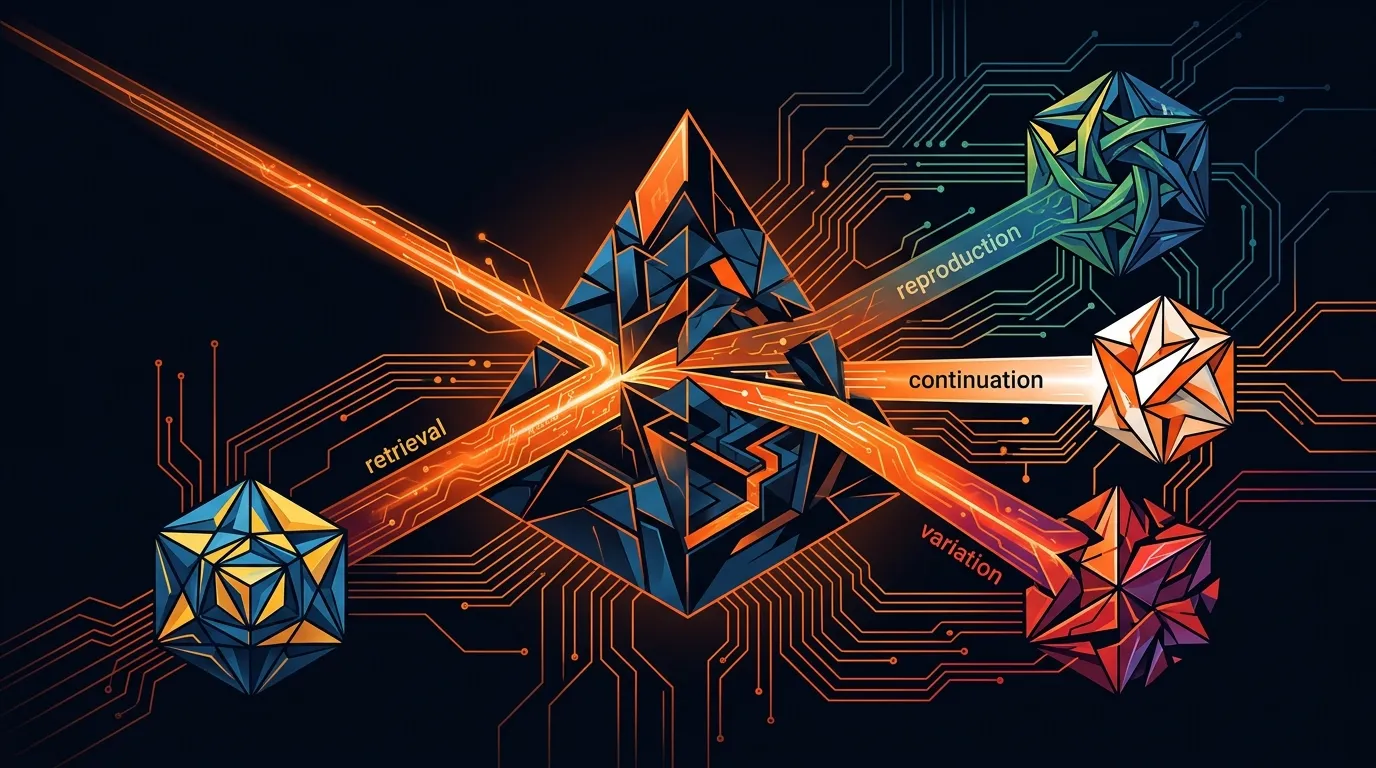
When a user asks for generation history, they're rarely asking for one thing. The request sounds singular, but underneath it there are at least four distinct needs — and most teams build for only the first one.
Retrieval is finding an old result. 'I generated something last Tuesday and forgot to save it.' That's the simplest case, and a grid of past outputs handles it fine.
Reproduction is running the same thing again and getting the same result. This sounds easy. It isn't. The visible prompt is only one piece of what produced that output. The model version matters. The specific controls and settings matter. Any hidden system instructions matter. If someone uploaded a reference file, that matters too. Save just the prompt text and you've created the illusion of reproducibility without the substance of it.
Continuation is something else entirely. It means reopening an earlier creative direction and carrying it forward — not cloning the output, but picking up the thread. This is where most history implementations fall completely flat, because continuation requires decisions the product probably hasn't made yet. Does opening an old result repopulate the form? Does the next generation branch off or overwrite? Do related results stay grouped together? These aren't small UX details. They're foundational choices about how the product thinks about creative work over time.
Variation might be what users actually want most often, and it's the hardest to build. The user doesn't want the exact same output again. They want to keep most of it and change one thing. Keep the composition, different color palette. Same structure, tighter copy. Same idea, just narrower scope. A gallery of past outputs can't do any of that. It's a read-only archive of closed decisions.
The Naming Problem Is Also a Thinking Problem
Here's the thing about calling all four of these capabilities 'history': it makes it very easy to ship the simplest one and feel done. The feature has a name, users can access it, there's a page in the product. Checked.
But retrieval and continuation aren't different points on a spectrum of the same feature. They're different features that happen to live near each other conceptually. Treating them as one thing means the roadmap never gets specific enough to actually solve the harder problems.
This isn't a failure of ambition. It's a failure of definition. If your team's internal spec says 'users can view their generation history,' that sentence is technically satisfied the moment you build a grid. The harder questions — can they reproduce it exactly, can they branch from it, can they modify one element while locking others — never get asked because the feature is already 'done.'
The fix isn't complicated. It's just uncomfortable. You have to name the four capabilities separately, scope them separately, and be honest about which ones you've actually built.
What Other Tools Get Right (and Wrong)
Non-AI tools have been solving version history for years, and they've made real progress — though often in narrow domains.
Code editors and IDEs treat history as a branching tree, not a flat list. You can check out any prior state, make changes, and those changes become their own branch. The old state is never destroyed. Figma does something similar with version history: you can name snapshots, restore to them, and the restoration itself becomes a new point in the timeline rather than erasing what came after. Google Docs tracks every keystroke and lets you step through changes like a film reel.
None of these map cleanly onto generative AI products, but they all share one design principle worth stealing: the past is a place you can work from, not just look at. The moment you treat old outputs as static artifacts rather than active starting points, you've already limited what your history feature can do.
The variation problem is harder, and most tools don't solve it well even outside AI. Photoshop's history panel lets you step back through actions, but it's linear — you can't fork from step 12 without losing steps 13 through 40. AI image tools like inpainting get closer to what users want (change this region, keep everything else), but that capability usually lives in a separate 'edit' workflow rather than being integrated with history. The two things feel disconnected precisely because teams built them at different times, for different reasons, without a unified model of what 'continuing from a past result' should mean.
The Reproducibility Trap Is Subtle
Reproducibility deserves its own attention because it fails in a particularly sneaky way. A saved prompt looks like it should be enough. The user sees the text they typed, they click regenerate, and they get... something different. Maybe slightly different, maybe very different, depending on how much has changed under the hood.
Model versions drift. Provider APIs get updated. Temperature settings that weren't saved default to something new. A reference image that was uploaded in the original session is no longer attached. The prompt is the same. The output is not.
This is frustrating in a specific way that erodes trust. Not the dramatic 'this product is broken' kind of trust erosion, but the quieter 'I can't rely on this' kind. Users stop trying to reproduce results because they've learned it doesn't work. They start downloading everything immediately after generation because the history tab has proven unreliable. The feature that was supposed to reduce anxiety about losing work ends up creating a different anxiety about whether anything is actually preserved.
The fix is unglamorous: capture the full generation context, not just the prompt. Every control value. The model version. Any system prompt or hidden instruction. File references, even if the files themselves are hard to store long-term. Generation settings. Store all of it alongside the output, and surface it when the user tries to reproduce. That's the only way 'regenerate' can mean anything consistent.
Scoping Honestly Is the Actual Deliverable
None of this means you shouldn't ship the simple gallery. Retrieval is genuinely useful. Users do forget to download things. They do want to revisit earlier directions. A grid of past outputs has real value — it just has a much narrower value than the word 'history' implies.
The productive move is to be explicit about the scope, both internally and with users. If your history feature supports retrieval but not reproduction, say so. Not in a disclaimer buried in docs, but in the product itself. 'View your past generations' is more honest than 'Your history.' It sets the right expectation and it stops the team from mentally filing the problem as solved.
Then treat the remaining three capabilities as separate roadmap items with their own definitions of done. Reproducibility requires a different data model. Continuation requires explicit UX decisions about branching and state restoration. Variation requires a different interaction paradigm altogether — probably something closer to an editing interface than a history list.
The teams that get this right aren't necessarily the ones with more engineering resources. They're the ones who asked the uncomfortable question early: when a user says they want history, what do they actually need to do next? Answering that question honestly, before you build anything, is worth more than any amount of polish on a feature that was scoped too narrowly from the start.
A gallery is a fine thing to ship. Just don't mistake it for a workflow.
Share this article
Join the newsletter
Get the latest insights delivered to your inbox.