The Gap Between Grocery AI Promises and Reality
Albertsons' AI shopping assistant sounds impressive. But the real test isn't how fast it builds a cart — it's whether the back-end can actually deliver.
The Four-Minute Promise
Albertsons says its AI shopping assistant can cut a grocery run from 46 minutes down to four. Four minutes. That's faster than most people spend deciding what to have for dinner, let alone actually buying the ingredients.
Impressive? Absolutely. But here's the catch: the moment you compress a decision that used to take 46 minutes into four, you've also compressed the window between expectation and disappointment. The shopper who spent 46 minutes browsing had time to notice the strawberries looked a bit sad and swap them out. The shopper who clicked through a recipe-to-cart conversion in four minutes? They're finding out at home.
That's the tension sitting at the center of grocery AI right now. The front-end experience is getting genuinely better — more conversational, more intuitive, less like typing keywords into a search box and hoping for the best. But the back-end? That's where promises go to die.
What the Interface Hides
It's easy to focus on the chatbot. It's visible. It's new. It lets customers say 'I need a weeknight pasta that feeds four under thirty dollars' and get a populated cart back. That's a real improvement over hunting through category pages.
But grocery is a physical business. Items run out. Produce spoils. Promotions get attached to SKUs that haven't been restocked since Tuesday. A delivery slot that looks open at noon might be overcommitted by the time a picker starts pulling the order.
None of that shows up in the interface. It shows up in the customer's kitchen.
A missing item isn't just a stock problem — it's a broken promise. A bad substitution isn't just a picker's judgment call — it's a personalization failure that lands on the customer's doorstep. Spoiled berries aren't a supply chain issue the customer cares about understanding. They're just spoiled berries, and now the customer doesn't trust the retailer.
This is why the real story of grocery AI isn't the assistant. It's everything the assistant is drawing from.
The Invisible CX Layer
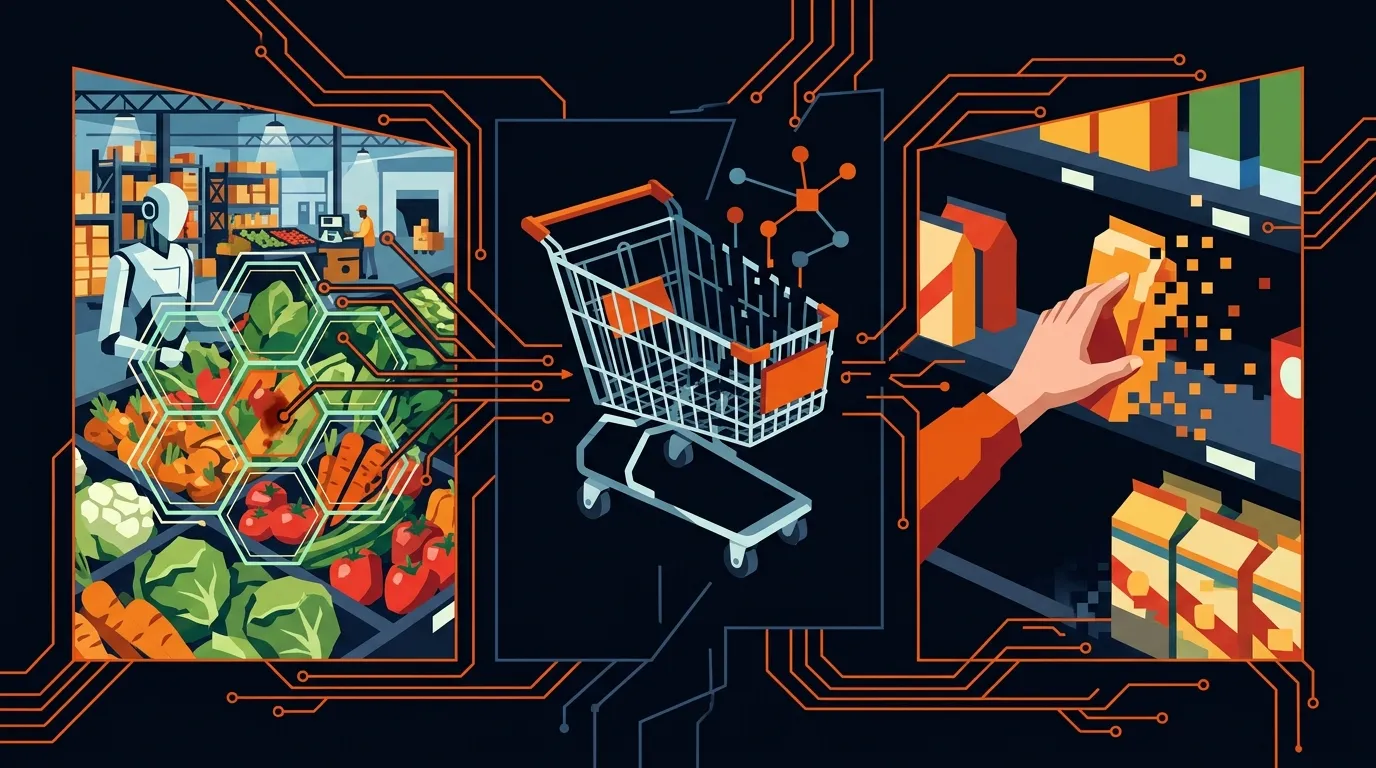
Albertsons is actually doing something interesting on the operational side, even if it gets far less attention than the shopping assistant. The company uses Google Cloud's Gemini AI in a tool called Intelligent Quality Control, which helps distribution center workers evaluate incoming produce before it reaches stores. A worker photographs a batch of strawberries or grapes, and the AI flags issues — blemishes, inconsistent sizing, anything that signals the product won't meet expectations.
Customers never see this. They don't know it exists. But they feel the result the moment they open a clamshell at home and find fruit that actually looks like the photo on the app.
That's invisible CX. It's customer experience work that happens entirely out of the customer's view, in a warehouse, during an inspection step that most shoppers would never think about. And it matters more than most front-end personalization features, because it's the difference between a promise kept and a trust problem.
The broader point here is that operational AI and customer-facing AI aren't separate initiatives. They're two halves of the same commitment. A retailer can build the most sophisticated shopping assistant in the industry, but if the produce quality check is still someone's subjective opinion on a busy Tuesday morning, the assistant is writing checks the operation can't cash.
Where the Chain Actually Breaks
Think about what has to go right between 'the AI built my cart' and 'I'm happy with my order.'
First, the assistant has to create a reasonable promise — not just what the customer wants, but what the store can actually deliver. That means the system needs to know what's in stock, what's fresh, what promotions are genuinely available, and what delivery windows are realistic. If any of that data is stale or disconnected, the promise is built on sand.
Second, someone has to verify that promise is still true at the moment the order is committed. Inventory counts drift. A product that showed available at 9 AM might be gone by 11. Produce that passed inspection at the distribution center might have had a rough ride to the store. The gap between 'available in the system' and 'actually on the shelf in good condition' is where a lot of grocery AI breaks down.
Third, the people executing the order — pickers, packers, delivery drivers — need enough decision support to handle the gaps. What do they substitute when the preferred item is gone? How do they flag a quality issue without derailing the whole order? If they're operating on instinct and informal rules, the customer's experience becomes a lottery.
Fourth, the fulfillment commitment itself has to be calibrated correctly. Confirming an order too early, before the real constraints are known, means the system is essentially gambling with the customer's expectations. Some retailers have learned this the hard way: the confidence the app projects at checkout doesn't always survive contact with reality.
And fifth — the failure mode that probably generates the most customer service contacts — is what happens when something goes wrong and the customer finds out too late, with no good options left. The notification that arrives after the delivery window. The substitution nobody approved. The refund that requires three contacts to process.
Each of those five points is a place where the promise chain can snap. And the faster the front-end AI moves, the more brittle that chain becomes if the back-end isn't keeping up.
The Employee Problem Nobody Talks About
There's a piece of this conversation that tends to get skipped over entirely: the people in the middle.
Frontline grocery workers — the ones picking orders, inspecting produce, handling substitutions — are the last human layer between what the AI promised and what the customer actually receives. And they're often the least equipped to close that gap.
Albertsons' produce quality tool is a good example of what it looks like when you actually invest in that layer. Instead of asking a distribution center worker to make a judgment call on a crate of strawberries based on experience and gut feel, the system gives them an AI-assisted evaluation. That's not replacing the worker — it's giving them better information to work with.
The alternative, which is more common, is to build increasingly sophisticated customer-facing AI while leaving the people who execute the promises with the same tools they had five years ago. That just moves the problem downstream. The AI sets a high expectation; the worker without adequate support fails to meet it; the customer blames the retailer.
Employee experience and customer experience are the same thing in this context. You can't separate them. The warehouse inspector who catches a bad batch of grapes before they ship is doing customer experience work, even if nobody in the CX org thinks of it that way.
The Competitive Pressure Making This Worse
Albertsons isn't alone here. The whole grocery industry is moving toward AI-assisted shopping, and the competitive pressure to ship impressive front-end features is real. A retailer that can show a four-minute shopping experience has a compelling story to tell. A retailer whose back-end integration project is six months behind schedule doesn't have much to announce.
That creates a structural incentive to build the visible stuff first and figure out the operational layer later. Which is exactly backwards.
The retailers who will actually win on customer trust aren't necessarily the ones with the most conversational AI. They're the ones who've done the unglamorous work of connecting their inventory systems, their freshness data, their fulfillment infrastructure, and their exception-handling workflows to the promises the AI is making. That's not a model capability problem. It's an integration problem. And integration work is slow, expensive, and almost impossible to demo at a press event.
Smaller regional grocers face an even steeper version of this challenge. The technology investment required to genuinely connect front-end AI to back-end operational systems is significant. The Albertsonses of the world have the budget and the engineering teams to take a run at it. A regional chain with thirty stores and a legacy inventory system is in a very different position — and 'deploy an AI shopping assistant' might create more customer experience problems than it solves if the operational foundation isn't there.
What a Real Test Looks Like
Here's a practical way to think about whether a grocery AI deployment is actually ready: trace a single order from the moment the assistant builds the cart to the moment the customer opens the last bag.
What promise did the AI make? What data confirmed that promise was true at the moment it was made? Who executed the order, and what tools did they have? When did the system commit — and was that commitment based on real operational confidence or just optimism? And when something went wrong, how did the customer find out, and what happened next?
If you can answer all five of those questions clearly, with connected systems behind each answer, you probably have a grocery AI deployment worth being proud of. If any of those answers is 'we're not sure' or 'the systems don't talk to each other yet' — the front-end experience might be impressive, but the customer experience is fragile.
The four-minute shopping promise is genuinely exciting. But the question worth asking isn't whether the assistant can build a cart in four minutes. It's whether the retailer can actually deliver what's in that cart, in the condition the customer expects, at the time they were promised. That's a much harder problem. And it's the one that actually determines whether customers come back.
Share this article
Join the newsletter
Get the latest insights delivered to your inbox.